

Table of contents
The brief lands on your desk asking for “a video,” and nobody has said which kind. Most teams default to an explainer because that’s the word they know, then wonder why demo requests didn’t move. The two formats solve different problems at different points in the buying cycle, and picking the wrong one is an expensive way to find that out.
This post gives you the answer up front, a table you can scan, and the buying-stage logic behind it. If you already know you need the top-of-funnel version, the explainer video production page covers that lane directly.
TL;DR:
- Explainer video: for buyers who don’t yet understand what you do. Lives on the homepage and in ads. Sells the problem and the outcome.
- Product demo video: for buyers who already get it and want to see it work. Lives on product pages, in sales follow-up, and in onboarding. Shows the real interface.
- Most SaaS teams need both, and the explainer is usually built first because it feeds the demo.
- Neither is right if your buyer wants to click through the product themselves. That’s an interactive demo tool, not a video.
The short comparison
| Decision variable | Explainer video | Product demo video |
|---|---|---|
| Buyer stage | First contact, cold | Evaluating, shortlisting |
| Core question it answers | Why should I care? | How does this actually work? |
| What’s on screen | Problem, outcome, light product | Real interface, real workflow |
| Typical length | 60 to 90 seconds | 2 to 3 minutes |
| Where it lives | Homepage, paid ads, social | Product pages, sales follow-up, onboarding |
| Success signal | Demo requests, trial starts | Deals moving, fewer repeat questions |
What an explainer video is for
An explainer talks to someone who doesn’t know your category or doesn’t know you. It opens on a problem they recognize, shows the outcome you deliver, and gets out.
The product appears, but it isn’t the point. The point is that a cold visitor understands what you do in under two minutes and takes one step forward. Details get skipped on purpose, because detail loses people who haven’t decided to care yet.
Cut it short and place it where attention is thin. Homepages, paid campaigns, and social all reward a tight explainer.
What a product demo video is for
A demo video talks to someone who has already decided the category matters. They’re comparing you against three or four other tools and they want to see the thing work.
This one shows the real interface. Real screens, a real workflow, and the actual result at the end. The buyer is checking whether it fits their situation, so the video has to be specific in the exact places the explainer was vague.
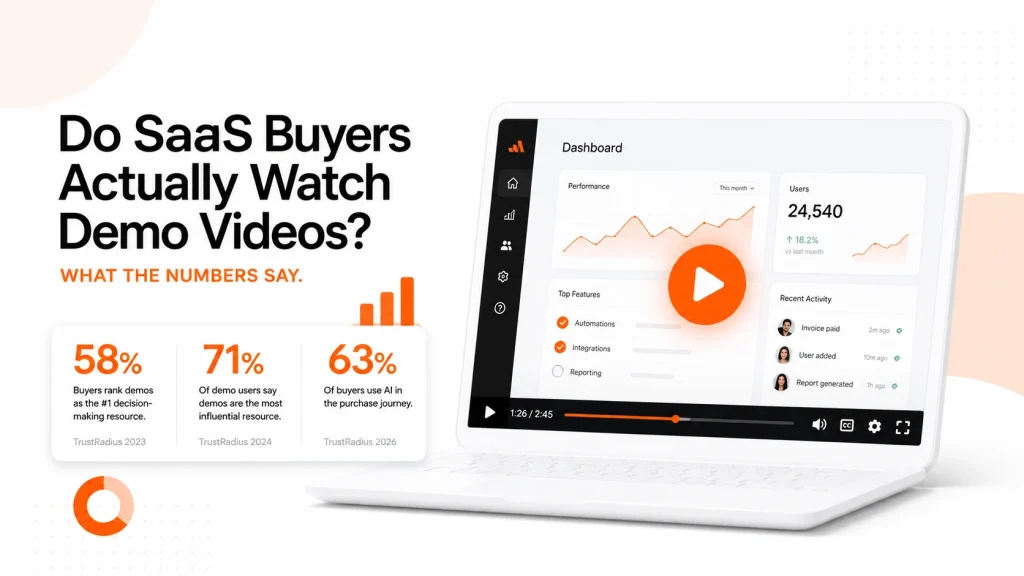
TrustRadius has tracked this for years in its B2B Buying Disconnect research. In its 2023 report, based on 1,604 tech buyers and 248 vendors, product demos ranked as the single most important decision-making resource, named by 58 percent of buyers. Its 2024 report found that 71 percent of buyers who used demos said demos were the most influential resource they consulted. In the 2026 report, based on 1,862 buyers and 444 vendors, demos still sit among the most influential resources alongside free trials, prior experience, and user reviews.
The demand is real and it’s stable. Our guide to product demo video goes deeper on how to structure one.
The mistake that wastes the budget
Teams put demo-level detail into an explainer. The video runs three minutes on the homepage, walks through six features, and loses the cold visitor who only wanted to know what the product does.
Or the reverse: a demo video that opens with two minutes of problem framing for a buyer who already booked the call. They’re waiting to see the software and you’re still explaining the category back to them.
Match the content to what the viewer already knows. A visitor on your homepage and a prospect three weeks into evaluation are not the same person, and one video can’t serve both without failing one of them.
Which to build first
If you only have budget for one this quarter, the answer depends on where deals are stalling.
Traffic arrives and bounces without understanding the product? Build the explainer. The leak is at the top.
Plenty of demo requests but slow, repetitive sales cycles where you explain the same workflow every call? Build the demo video. The leak is in the middle, and a demo video is sales enablement that scales.
For most SaaS teams the explainer comes first, because it feeds everything downstream. The script work, the brand system, and the animated product screens all get reused when the demo video follows. Building the second one costs less than building it cold.
When the answer is neither
Some buyers don’t want to watch anything. They want to click through the product at their own pace and poke at the parts they care about.
That’s an interactive demo, and it’s a different category of tool. Platforms like Storylane, Navattic, Walnut, and Reprise capture or clone your real interface so a prospect can move through it themselves. If your buyers are hands-on and self-serve, start there rather than with a video.
Video and interactive demos also work well together. The video sets up the story and the interactive demo lets them explore. Plenty of go-to-market teams run one of each.
And if what you actually need is a customer testimonial shot on camera, or a brand film, Studio Monday isn’t your shop. The studio does 2D and 3D animation and doesn’t shoot brand films, commercials, or event recaps. Slow Clap or Indigo handle that work.
The honest answer
There’s no universal right format, only a right format for where your buyer is standing. Cold traffic needs an explainer. Active evaluation needs a demo. Hands-on self-serve buyers may need neither and want a clickable tour instead.
Studio Monday builds the animated versions of both, for B2B SaaS and tech products. Delivery is 14 days from kickoff, against an industry benchmark of four to eight weeks, with unlimited revisions and pricing published at $4,745. The record is checkable: over 300 videos for more than 100 companies, including Bitdefender and Rehmann.
If you’re not sure which one your situation calls for, book a call and walk us through where deals are stalling. If the answer is an interactive demo tool instead of a video, we’ll say so.