

Table of contents
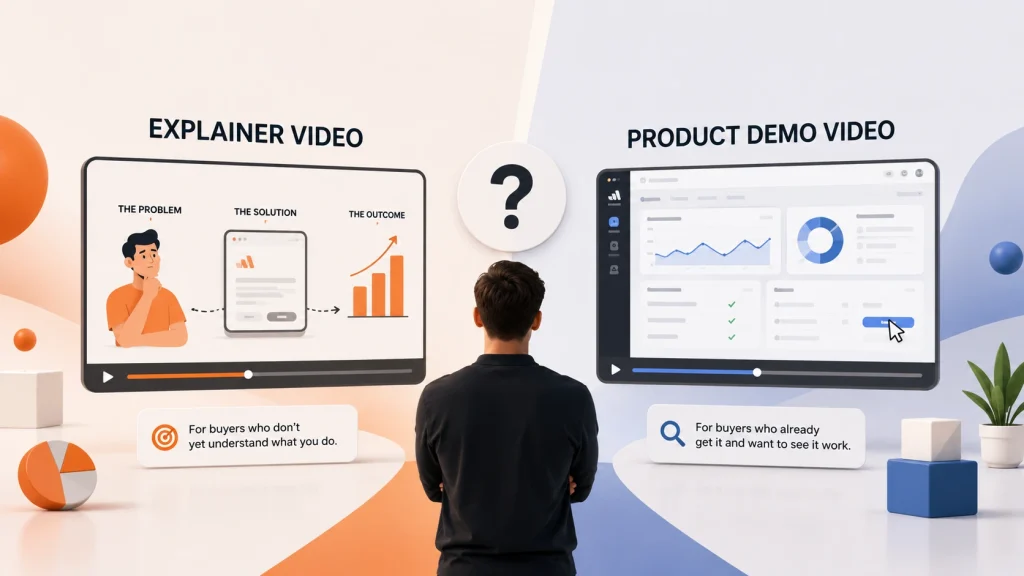
Watch ten B2B explainer videos in a row and most will blur together. Nice music, smooth animation, confident voiceover, and at the end you still could not say what the product does. The video looked like a success, yet it explained nothing.
This is the quiet failure mode in B2B video. The work gets approved because it looks professional. Nobody asks the harder question: did a stranger understand the product after watching? Often the answer is no.
Here is why these videos miss, and how to make one that actually does its job.
Failure 1: It starts with the company, not the viewer
Many scripts open with the brand: the name, the tagline, a line about the mission. The viewer does not care yet. They came with a problem, and the video is talking about itself.
A buyer gives you a few seconds before they decide to keep watching. Spend those seconds on them. Name the problem they already feel, in words they would use. When someone sees their own frustration on screen, they lean in. Then you have earned the right to introduce the product.
Failure 2: It explains everything, so it explains nothing
This is the most common one. The product does fifteen things, so the video tries to show all fifteen. The result is a tour that no one can follow.
People cannot hold a long list in their heads while watching. Pick the one outcome that matters most to the buyer you are targeting, and build the whole video around that. The other features are not lost. They live on the page, in the demo, and in later videos. A focused video that lands one idea beats a busy one that lands none.
If your team cannot agree on the single most important point, that is the real work. Solve it before the camera or the animation starts.
Failure 3: It hides the product
Some explainers are all metaphor: floating shapes, clouds, abstract characters, and never a glimpse of the actual software. For a B2B buyer who is comparing tools, that is a problem. They want to see what they are buying.
Showing real product UI, even simplified and cleaned up, makes the video honest. The buyer pictures themselves using it. We work from Figma files when teams have them and from screenshots when they do not, then polish those screens so they look sharp in motion. The viewer should recognize the real thing.
For products that are genuinely hard to picture, this matters even more. If you sell to technical and complex product teams, the video has to make an invisible system feel concrete. Pure abstraction leaves the buyer guessing.
Failure 4: The script is written like a brochure
Read most explainer scripts out loud and they sound like a website, not a person. They are full of long sentences and stacked jargon that no one says out loud.
Video is spoken, so it should sound spoken. Use short sentences and plain words, with one idea per line. If a sentence makes the voiceover artist run out of breath, it is too long for a viewer to follow. We read every script aloud during writing for exactly this reason.
Plain does not mean dull. A clear line with a bit of personality beats a clever line that needs a second listen.
Failure 5: There is no reason to act
The video explains the product, then just ends. No clear next step. The viewer nods and clicks away, and the moment is gone.
Every explainer should point somewhere, whether that is starting a trial, booking a demo, or seeing pricing. Make the step obvious and make it easy. The best moment to ask is right after the viewer understands the value, while the interest is fresh.
Failure 6: It was built by committee
Many weak videos are not one person’s fault. They are the product of too many cooks. Marketing wants the brand front and center, sales wants every feature mentioned, product wants technical accuracy, and a leader wants their favorite phrase in there somewhere. The script tries to please everyone and lands with no one.
Strong explainers come from a clear owner and a single point of view. Gather input early, then give one person the final call on the message. A video written to satisfy a room will always say too much. A video written for one buyer stays sharp.
This is also the failure that budget cannot fix. You can spend more on animation and still ship a muddled video if five people are steering the script.
What a working explainer looks like
A B2B explainer that does its job is easy to describe. It opens on the buyer’s problem, makes one outcome clear, and shows the real product. The script sounds like a person talking, and the video ends with one obvious next step.
None of that requires a giant budget. It takes a tight script and the discipline to cut, because the most useful skill in this work is leaving things out.
If you want to see the idea in practice, our roundup of explainer videos that get it right shows what clear looks like across different styles. The common thread is restraint, not spectacle.
When we build explainer video production, the script gets the most attention, because that is where videos are won or lost. We handle scripting, voiceover, music, sound design, and animation as one package, with unlimited revisions, so the message stays sharp from first draft to final cut.
The real test is whether a stranger understood your product in 90 seconds. If yours does that, it is working. If it does not, the polish will not save it.
If your explainer is missing the mark, book a call and we will look at it with you. Public pricing starts at $4,745, and delivery is 14 days.