
Table of contents
When a software team plans an explainer video, one of the first questions is format. Animated or live-action? Both can work. They just fit different products, budgets, and timelines, and picking the wrong one wastes money.
We build animated explainers, so we have a view here. But this is meant to be a fair look at the tradeoffs, including the cases where live-action is the better choice. By the end you should know which one fits your product.
What each format is good at
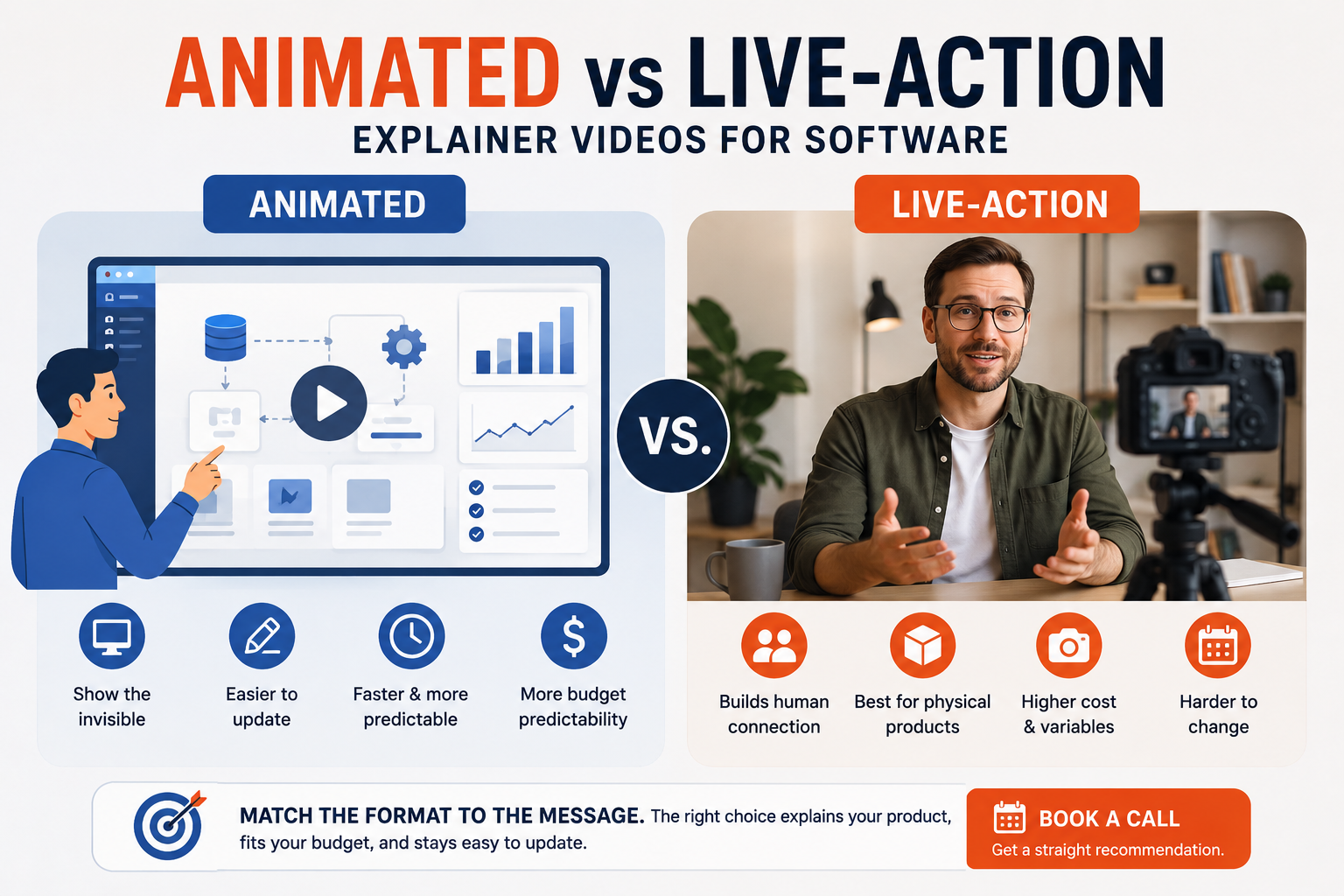
Live-action means filming real people with a camera in a real setting. It builds a human connection fast. You see a face, hear a voice in a real room, and the brand feels tangible. For founder stories, customer testimonials, and culture videos, live-action is hard to beat.
Animation means the visuals are drawn and moved by design rather than filmed. It can show things a camera cannot, like data moving through a system, a workflow across screens, or an abstract idea made visible. For explaining how software works, that flexibility is the whole point.
Neither is better in general. They are better at different jobs.
Why software usually leans animated
Most SaaS and tech products live on screens, and a lot of what they do is invisible. Data syncs in the background, automations run, and integrations connect tools where no one can see them. You cannot point a camera at that.
Animation can. It can zoom into an interface, follow a record through a pipeline, and turn a hidden process into something a buyer can watch and follow. When the product is the star, animation lets you show it clearly, even the parts that have no physical form.
There are practical reasons too. Software changes. An animated video built from your interface is easier to update when the UI shifts than a live shoot you would have to schedule all over again. You also skip the cost and coordination of a film crew, talent, and locations.
This is why our SaaS video production work is animation-first. The format matches what these products need to communicate.
Where live-action still makes sense
Animation is not the answer for everything. A few cases point the other way.
You are selling trust through people. If your message is about your team, your service, or a human relationship, seeing real faces helps. A wealth advisor or a hands-on agency may want live-action for that reason.
The product is physical. Hardware, devices, and anything you hold benefit from real footage, because you want the buyer to see the object as it is.
You want raw authenticity. Some brands choose a rough, founder-on-camera look on purpose, because it feels honest and unpolished. Animation, by nature, is more produced.
Plenty of strong videos also mix the two: live footage for the human moments, animated overlays to explain the parts a camera cannot show. The choice is not always one or the other.
The cost and timeline difference
Budgets vary widely, so treat this as direction, not exact numbers. In general, live-action carries more variables that drive cost and schedule: crew, talent, location, gear, travel, and reshoots if something goes wrong on the day. Each one adds money and time.
Animation moves the cost into design and production rather than a shoot. The timeline is more predictable because the work happens at the desk, not on a set that depends on weather, availability, and a dozen people in a room.
Predictability matters when you have a launch date. Our animated explainer video production ships in 14 days with public pricing that starts at $4,745, because the process has fewer moving parts to slip. A live shoot of the same scope is harder to lock to a fixed date.
If you want to compare looks before you decide, our overview of explainer video styles shows how different animated approaches feel on screen.
Think about the next two years, not just launch day
A video is not a one-time asset. Your product will change, and the video should keep up. This is where the two formats really split.
When you ship a new feature or redesign the interface, an animated explainer can be updated. The scenes were built in software, so a studio can swap a screen or adjust a flow without starting over. A live shoot is far harder to change. Reopening it often means booking the same talent, the same crew, and the same location again, if you even can.
So day-one production is only part of the cost. The bigger number, for a product that keeps changing, is what you spend to keep the video accurate over the next two years. For a fast-moving SaaS product, animation usually wins that longer math, because the updates stay cheap and quick.
How to choose for your product
Ask what you most need the viewer to understand. If it is how your software works, especially the invisible parts, animation will show it more clearly. If it is who your people are, or a physical product in hand, live-action will land it better.
Then weigh the practical side. A fixed launch date and a product UI that keeps changing both favor animation. A one-time brand film with real people may justify a live shoot.
For most B2B software, the honest answer is animation, because the job is explaining a screen-based product fast and keeping it easy to update. For a smaller set of human-centered or physical stories, live-action wins. Match the format to the message and the math gets easier.
Not sure which way to go? Book a call and tell us what your product does. We will give you a straight recommendation, even if that means pointing you toward live-action.