
Table of contents
You’re trying to get a demo video funded and someone in the room has said buyers don’t watch them anymore. It’s a reasonable challenge, and most answers to it come from agencies quoting stats that serve the sale. The published buyer research says something more useful, and also more specific, than “yes they do.”
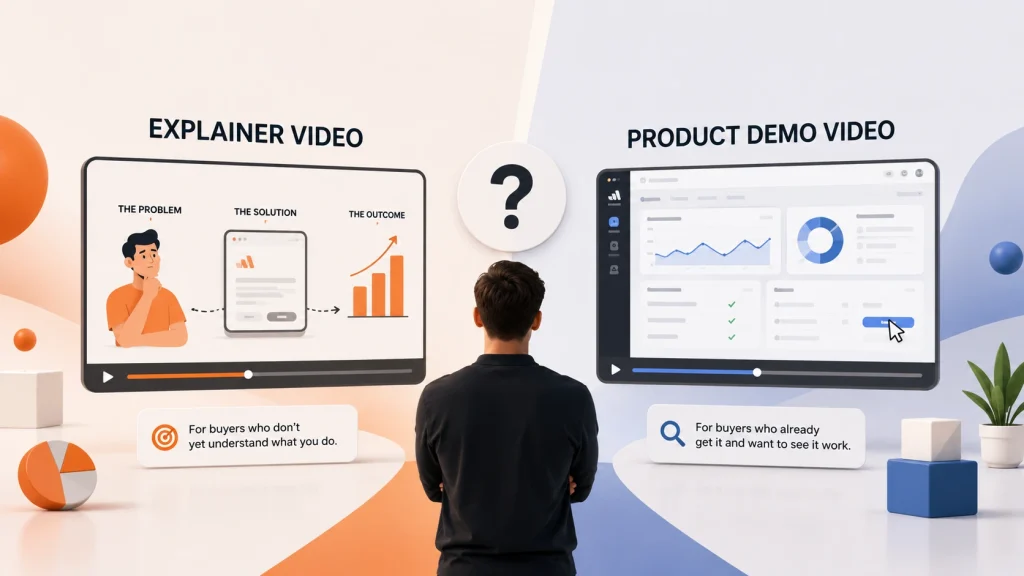
This post pulls the numbers from named sources, separates what buyers mean by “demo” from what marketers mean, and ends with the cases where a demo video is the wrong spend. If it turns out you need the top-of-funnel version instead, the explainer video production page covers that.
What the buyer research actually reports
TrustRadius runs an annual B2B Buying Disconnect study, surveying technology buyers and vendors. It’s the most consistent public tracking of this question, so it’s worth reading across years rather than cherry-picking one.
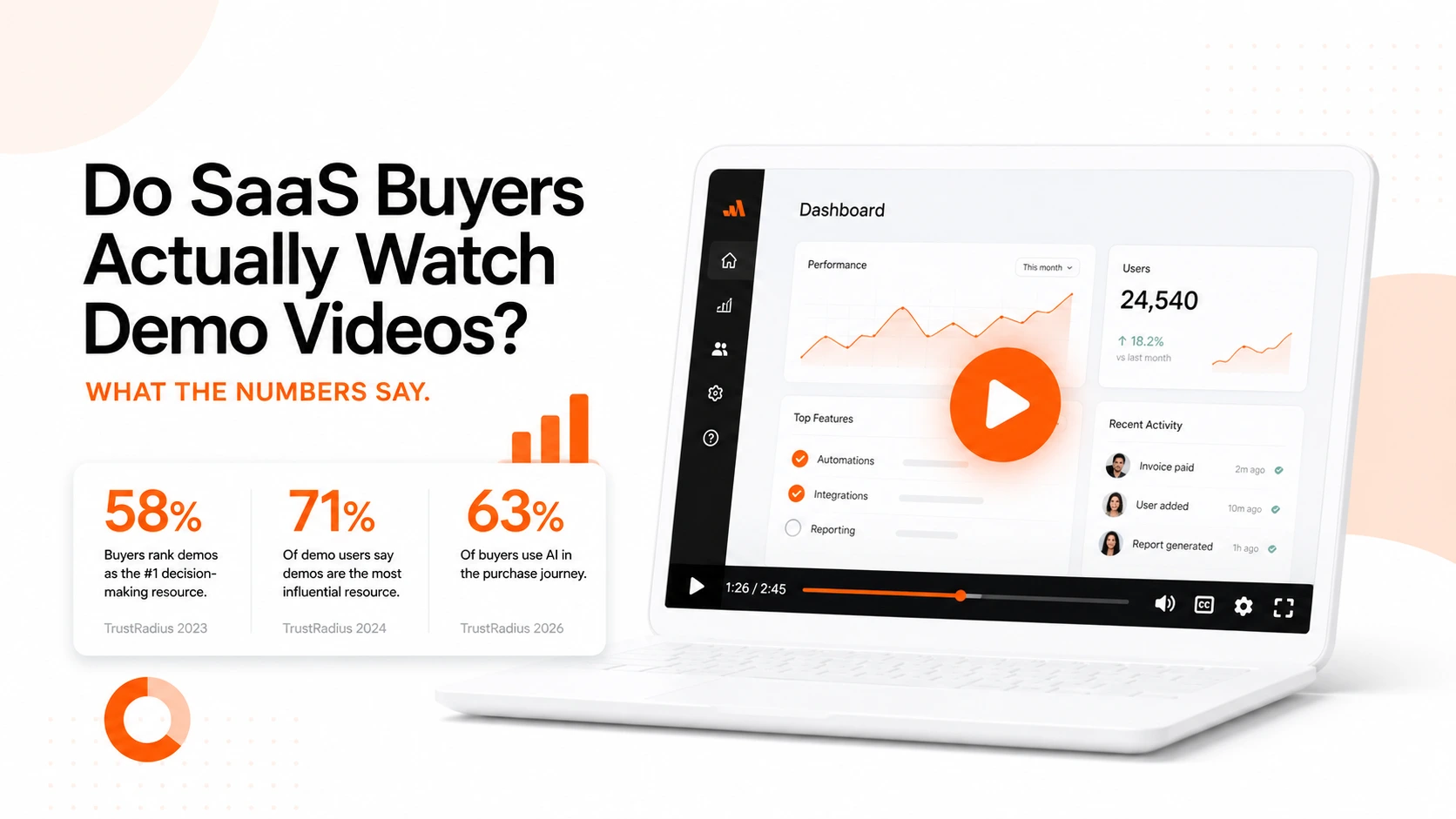
In the 2023 report, based on 1,604 tech buyers and 248 vendors, product demos ranked as the single most important decision-making resource, named by 58 percent of buyers.
The 2024 report went further on influence. Of buyers who used demos, 71 percent said demos were the most influential resource they consulted.
The 2026 report, published in July and based on 1,862 buyers and 444 vendors, found the pattern holding through the AI shift. Buyers ranked product demos, free trials, prior experience, and user reviews among the most influential resources when choosing a vendor. That report also found 63 percent of buyers used AI somewhere in their purchase journey, and 94 percent of those buyers fact-check what AI tells them.
So AI changed how buyers find software. It hasn’t changed what convinces them.
The distinction most posts skip
Here’s where the stats get misread, including by people selling video.
When TrustRadius asks buyers about “product demos,” that word covers several different things: a live demo call with a sales rep, a self-guided click-through of the product, a recorded walkthrough, and a demo video on a product page. Buyers don’t sort them the way marketers do.
That means the 58 percent and 71 percent figures aren’t evidence that a produced demo video specifically drives decisions. They’re evidence that seeing the product work is what moves buyers, in whatever form gets it in front of them.
That’s still a strong case for a demo video. It’s just an honest version of it, and it points to what the video has to do. A demo video earns its budget when it’s the fastest way to show the product working to someone who isn’t going to book a call yet.
What buyers say they want from a demo
TrustRadius has published buyer verbatims on this, and they’re more instructive than the percentages.
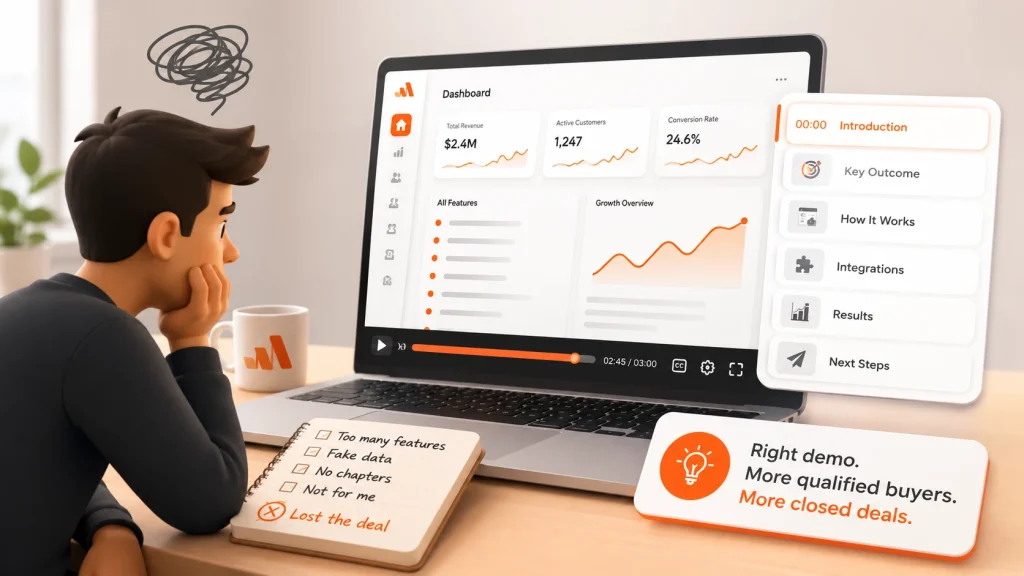
Buyers ask for a realistic, accurate version of the product, the one they’d actually be using. Not an idealized build with invented data.
They don’t want to sit through features they don’t care about, and many want to skip ahead.
They want to slow down and step through the parts that matter to them, with recordings or a sandbox they can revisit on their own time.
Read those together and the design brief writes itself. Show the real interface. Cut anything the target buyer doesn’t need. Make it easy to jump to the relevant part. A demo video that ignores those three things will get opened and abandoned regardless of how good the animation is.
What watch-time data adds
Wistia’s video research fills in the other half. Its analysis covers millions of business videos, including over 13 million videos and 79 million hours of viewing in the 2026 report.
Two findings matter here. Instructional content holds attention noticeably better than other video types, and it keeps holding it as videos run longer. A demo video is instructional by nature, which means it has more room than a promo does.
The second finding cuts the other way. Most viewers leave before the end of any video. So the thing you most need a buyer to see belongs early, not in a closing summary they never reach.
Together those point to a demo video that runs two to three minutes, opens on the outcome rather than the interface tour, and is chaptered so a buyer can find their own section fast. Our guide to product demo video breaks the structure down step by step.
When a demo video is the wrong spend
This is the part an agency blog usually leaves out.
If your product is simple and self-serve, a free trial probably beats a video. TrustRadius found in 2024 that 40 percent of buyers used free trials, and of those, 74 percent called trials the most influential resource they consulted. That’s a higher influence rate than demos scored. If a buyer can be inside your product in 90 seconds, let them be.
If your buyers are hands-on and want to click rather than watch, use an interactive demo platform. Storylane, Navattic, Walnut, and Reprise capture or clone your real interface so a prospect can move through it at their own pace. That’s a different tool for a different buyer, and it isn’t video work.
If your problem is that buyers can’t find your pricing, fix that before you fund a video. Transparent pricing has been buyers’ number one wish-list item in the TrustRadius research for four years running, since it started asking in 2023. Studio Monday publishes its own pricing for that reason, and you can see it on the pricing page without a call.
And if what you want is a live-action walkthrough with a presenter on camera, Studio Monday doesn’t shoot that. The studio does 2D and 3D animation.
The honest answer
Buyers watch demos. The published research has said so consistently for years, and the 2026 data shows AI hasn’t displaced it. What buyers won’t sit through is a feature tour built for your internal review rather than their evaluation.
So fund the demo video when your buyer needs to see the product work before they’ll take a call, when your sales team is repeating the same walkthrough on every call, or when the interface is the strongest argument you have. Skip it when a free trial does the job faster, and pick an interactive demo tool when your buyers would rather click than watch.
Studio Monday builds animated demo and explainer videos for B2B SaaS and tech companies. Delivery is 14 days from kickoff, against an industry benchmark of four to eight weeks, with unlimited revisions and pricing published at $4,745. The work is checkable: over 300 videos for more than 100 companies, including Bitdefender and Rehmann.
If you want a straight read on whether a demo video is the right spend for your product, book a call and tell us where deals are stalling. If a free trial or an interactive demo would serve you better, we’ll point you there instead.