
Table of contents
Your demo video has views and your pipeline doesn’t reflect them. Sales still walks every prospect through the same workflow on every call, which is the exact job the video was supposed to take off their plate. That gap almost always comes from the same handful of build decisions, and none of them are about animation quality.
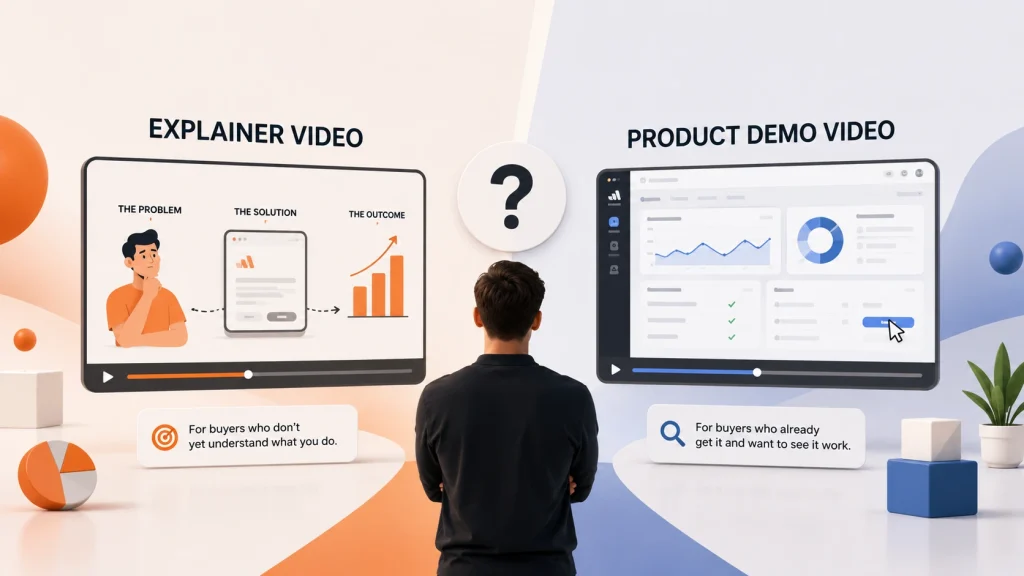
This post names the six failures we see most in B2B demo videos, with the fix for each, and closes with the cases where the video isn’t your problem at all. If your issue is further up the funnel, that’s a different format and the explainer video production page covers it.
Failure 1: It’s a feature tour instead of an outcome
The video opens on the dashboard and walks left to right through the navigation. Every module gets a mention. By minute two the buyer has seen eleven features and can’t name one reason to switch.
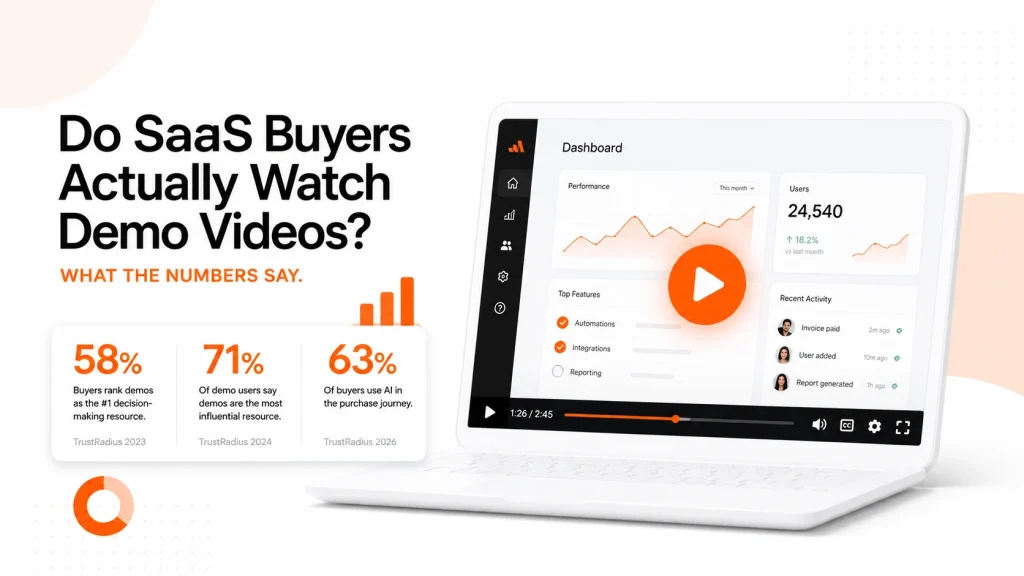
Buyers have told researchers this directly. TrustRadius has published buyer feedback saying they don’t want to sit through features they don’t care about, and that many want to skip ahead.
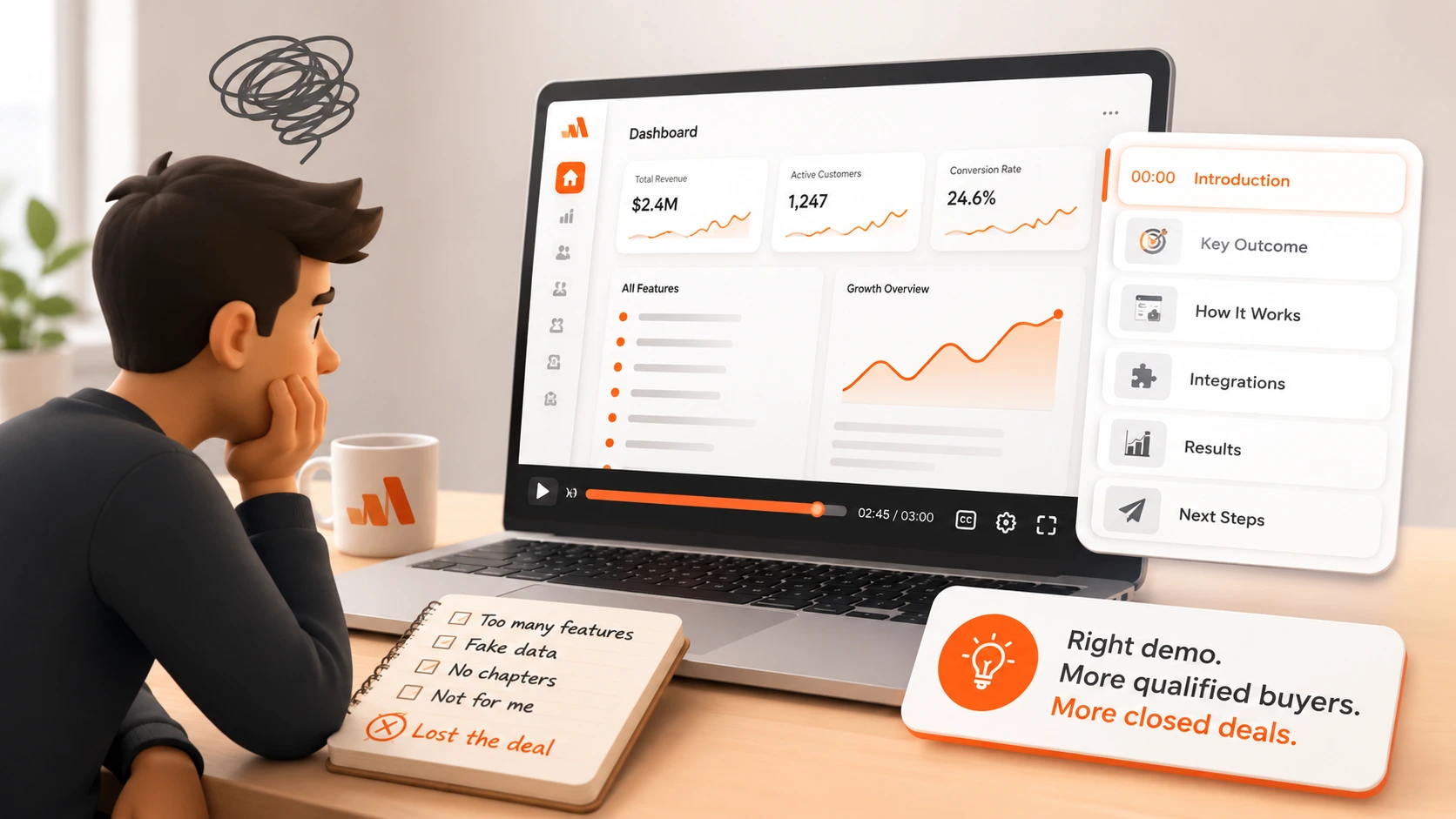
Fix it by picking one workflow that ends in a result the buyer wants, and building the whole video around that path. The other features aren’t lost. They belong on the product page, in the trial, and in the sales call.
Failure 2: The data on screen is obviously fake
Sample dashboards full of round numbers, companies called Acme, and a chart that only ever goes up. Every buyer evaluating software has seen a hundred of these and discounts them on sight.
TrustRadius buyer feedback is specific here too. Buyers ask for a realistic, accurate version of the product, the one they’d actually be using.
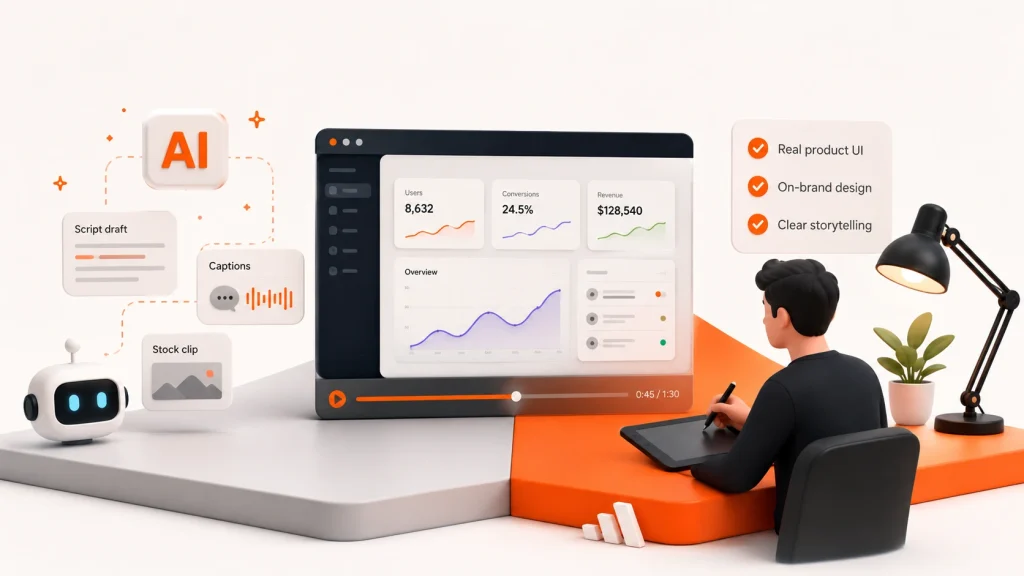
Fix it with plausible data. Real-looking record counts, names that could belong to an actual customer, and a chart with a dip in it. When we animate from a client’s Figma files or product screenshots, keeping the data believable is part of the polish, not an afterthought.
Failure 3: It explains the category to someone who already knows it
The demo spends its first 45 seconds on why the problem matters. The viewer already agreed the problem matters, which is why they’re watching a demo.
Wynter’s research into how B2B software buyers actually buy found that buyers arrive at vendor conversations having done the bulk of their research already, with a formed point of view and questions ready. Only a small minority show up unfamiliar.
Fix it by cutting the setup to one sentence. Name the job, then show it being done. Save the problem framing for the explainer, where the audience is genuinely cold.
Failure 4: There’s no way to jump to the relevant part
A three-minute demo plays as one uninterrupted block. A buyer who cares about one specific integration has to scrub the timeline hunting for it, and usually gives up instead.
Buyers have asked for the opposite. TrustRadius feedback describes wanting to slow down, step through, break the demo into parts, and revisit it on their own time.
Fix it with chapters and clear section titles, and by structuring the script so each section stands alone. This costs nothing at the script stage and is expensive to retrofit later.
Failure 5: The best moment is at the end
The payoff, the part where the product does the impressive thing, sits at 2:40 in a three-minute video. Almost nobody reaches it.
Wistia’s video research is consistent on this point across years of data, drawn from millions of business videos. Most viewers leave before the end. The finding that instructional content holds attention better gives a demo more room than a promo gets, and it doesn’t suspend the rule.
Fix it by showing the outcome first, then explaining how the product gets there. A buyer who sees the payoff at 15 seconds has a reason to stay for the mechanics.
Failure 6: It was built for the sales call, not the buyer alone
Many demo videos are a recording of the deck a rep presents live. A rep can read the room, skip ahead, and answer the question forming on someone’s face. The video can’t do any of that.
A buyer watching alone at 11pm has no one to ask. Anything ambiguous becomes a reason to close the tab.
Fix it by writing for the solo viewer. Answer the obvious objection inside the video, label what’s on screen, and end with one clear next step. Then let sales use the same asset as a leave-behind, which is where a demo video earns its keep as sales enablement.
When the video isn’t the problem
Sometimes the demo video is fine and something else is losing the deal. Worth checking before you commission another one.
Buyers can’t find your pricing. Transparent pricing has been the number one buyer wish-list item in TrustRadius research for four years running. No video fixes a hidden price.
Your buyers would rather click than watch. If they’re hands-on, an interactive demo platform serves them better. Storylane, Navattic, Walnut, and Reprise capture or clone your real interface for a self-guided walkthrough.
Your product is simple enough to try. TrustRadius found that among buyers who used free trials, 74 percent called the trial the most influential resource they consulted. If someone can be inside your product in 90 seconds, a video is a detour.
You need a presenter on camera. Studio Monday does 2D and 3D animation and doesn’t shoot brand films, commercials, or event recaps. For live-action work, Slow Clap or Indigo are the better call.
The honest answer
A demo video that loses deals is usually a scripting problem wearing an animation problem’s clothes. Every fix above happens before anything gets animated, which is also why re-cutting an existing video rarely rescues it. The structure was set in the script.
If you’re rebuilding, start there: one workflow, believable data, outcome first, chapters, written for someone watching alone. Our guide to product demo video walks through the full structure, and the SaaS video production page covers how this fits alongside the rest of your video set.
Studio Monday builds animated demo and explainer videos for B2B SaaS and tech companies. Delivery is 14 days from kickoff, against an industry benchmark of four to eight weeks, with unlimited revisions and pricing published at $4,745. The record is checkable: over 300 videos for more than 100 companies, including Bitdefender and Rehmann.
Send us the demo video that isn’t working and book a call. We’ll tell you whether it’s a re-cut, a rebuild, or a problem no video will solve. If it’s the last one, we’ll say that too.