
Table of contents
You have heard the rule. Keep your explainer video under 90 seconds, or even under 60, because attention spans are short and nobody watches past that. It gets repeated in every blog and every sales pitch. It is also wrong about as often as it is right.
The 90-second target is a useful default, not a law. For some products and some pages, a longer video is the one that earns more attention and more action. Here is when to break the rule, and the data that backs it up.
Where the rule comes from
The short-video advice is built on a real pattern. Viewers do drop off as videos get longer. Wistia, a video hosting platform, has analyzed millions of business videos and found that people watch a bigger share of short videos than long ones. For a quick promo or a homepage hook, tight and fast is the right call.
So the rule is not made up. It just gets applied too widely. A teaser and a detailed product walkthrough have different jobs, and forcing both under 90 seconds hurts the one that needs room.
What the data actually says about length
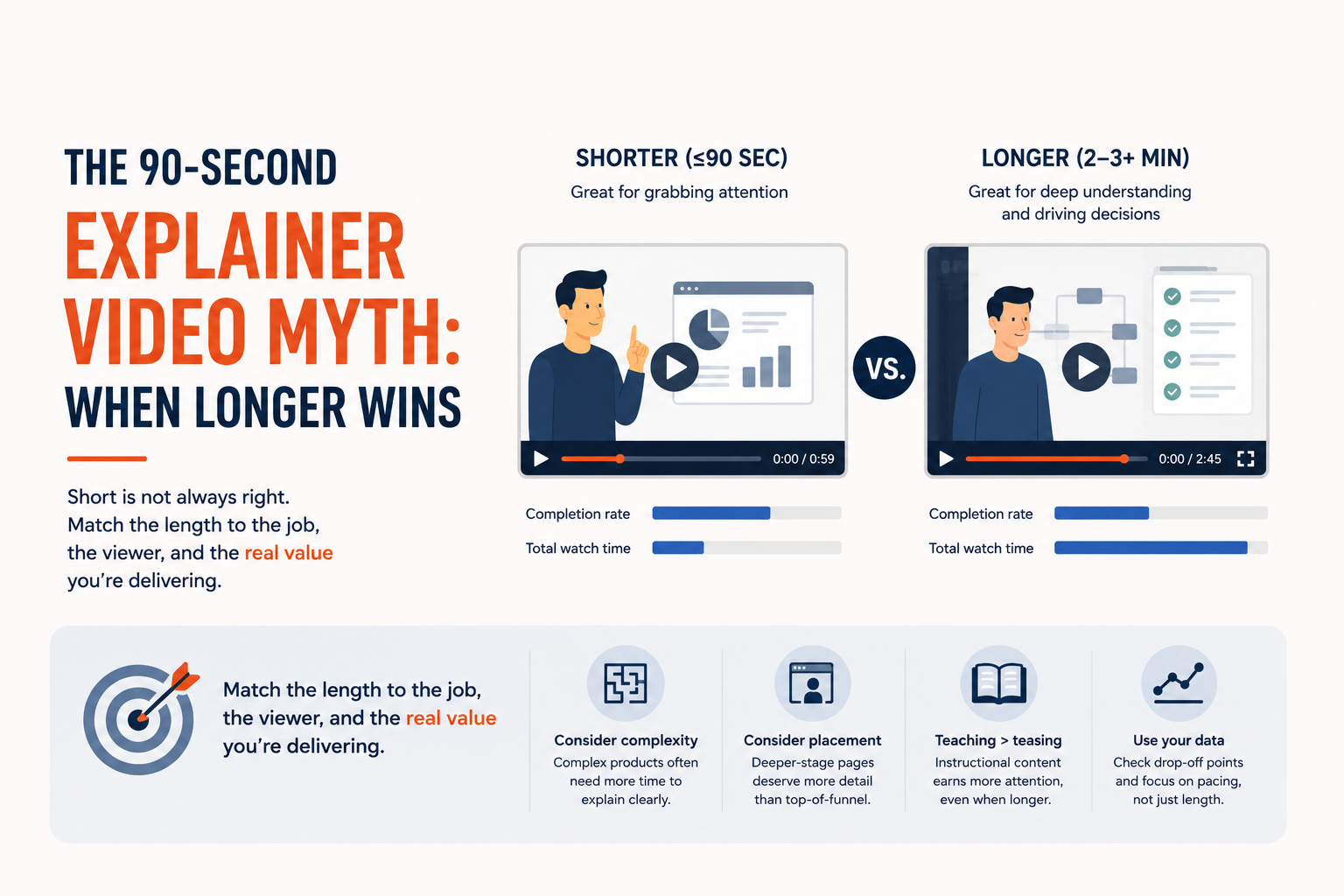
The same research adds a detail the short-video crowd skips. While viewers watch a smaller percentage of long videos, they spend more total time watching them. A longer video at a lower completion rate can still deliver more watch time than a short one at a higher rate.
There is more. Wistia found that instructional content holds attention far better than other types. Videos that teach something keep viewers engaged even as they run longer, while generic promos lose people faster. If your video is genuinely useful, length is less of a penalty than the rule suggests.
The practical takeaway is simple. Match the length to the job and to how much real value you are delivering, then put your key message early so no one misses it.
When a longer explainer wins
A few situations call for more than 90 seconds.
The product is complex. Some tools cannot be explained in a minute without leaving the buyer confused. A developer platform, a data product, or a multi-step workflow may need two or three minutes to actually make sense. A rushed video that skips the hard part is worse than a longer one that earns understanding.
The buyer is deep in research. On a homepage, attention is thin and short wins. On a pricing page, a comparison page, or a demo follow-up, the viewer has already chosen to dig in. They will give a longer video the time, because they are close to a decision and want detail.
You are teaching, not teasing. Onboarding videos, feature walkthroughs, and how-to content can run longer because the viewer came to learn. Cutting these short to chase a number leaves the job half done.
When short still wins
The rule holds in plenty of places, so keep it where it fits. A homepage hero video should stay tight, a social cutdown should be very short, and a paid ad needs to land in seconds. A product teaser works best when it leaves people wanting the demo rather than handing them everything. For top-of-funnel attention, shorter is usually safer.
This is why many teams get more from one project than one video. We often build a longer master explainer, then cut it down for ads and social from the same production. The long version does the explaining, and the short versions do the catching.
Test it with your own audience
You do not have to guess. Your video analytics will tell you where people drop off. Most hosting tools show an engagement graph for each video, so you can see the exact moment viewers leave.
If a big chunk leaves in the first ten seconds, the opening is the problem, not the length. If they stay until a slow middle and then go, that section needs tightening or cutting. Watch a few of your own videos this way and you will learn what your buyers will sit through. That beats any rule pulled from a blog.
When you find a drop-off point, fix the content there before you reach for the scissors on the whole video. Length is rarely the real issue. Pacing usually is.
How to decide the right length
Skip the fixed number and ask three questions. How complex is the idea you must land? Where will the video live, and how invested is the viewer on that page? Are you teasing or teaching? The answers point to a length far better than a blanket rule.
Then, whatever the length, front-load the message. Most viewers leave before the end, so the most important point should arrive early, not in a closing summary they never reach. This is true at 30 seconds and at three minutes.
The format matters too. A product launch video built for buzz behaves differently from a detailed explainer, and the right runtime follows the goal, not a template. If you want to see how runtime shifts with style, our breakdown of explainer video examples and styles shows the range.
When we plan explainer video production, length is a decision we make from the script and the placement, not a box we tick. Some projects land at 60 seconds, and others need three minutes. The brief decides.
The 90-second rule is a fine starting point. Just do not let it overrule your product or your buyer. Make the video as long as it needs to be to be clear, and not a second longer.
Want help sizing your next video to the job? Book a call and we will map it out with you. Public pricing starts at $4,745, with 14-day delivery.