
Table of contents
Most explainer videos look fine and still do nothing for the business. They get made, they get posted, and the demo requests stay flat. After making more than 300 videos for over 100 B2B software and tech companies, we have a clear view of what moves the needle and what gets ignored.
Everything here comes from real projects, from homepage explainers to feature videos. The patterns repeat, and they are simpler than most teams expect.
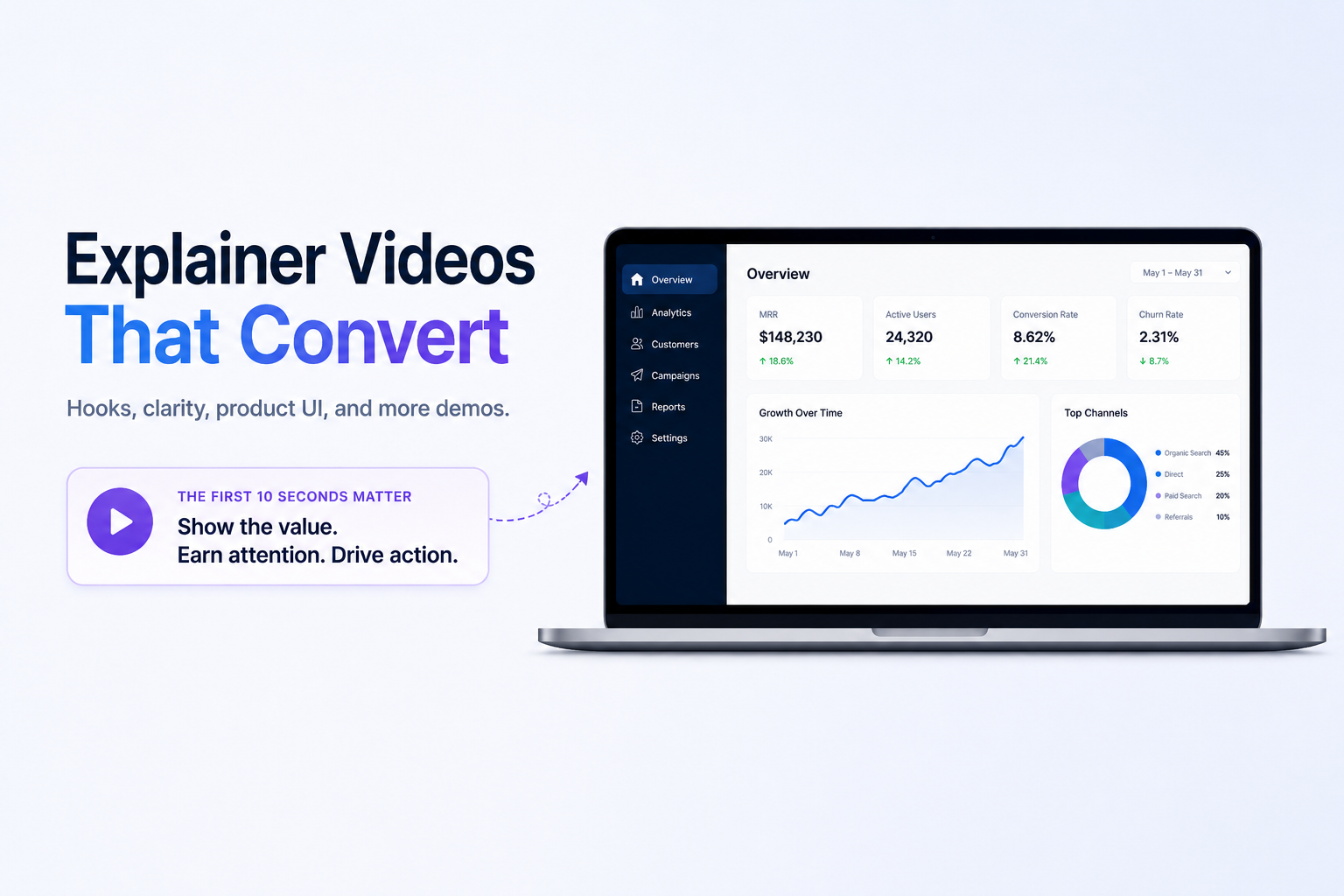
A video does not convert. The first ten seconds do.
Viewers decide fast. If the opening does not show them why they should care, they leave before the good part. We have watched this happen again and again. The videos that drive action open with the problem the viewer already feels, not with a logo animation or a company history.
So we start every script with the pain, said plainly. A cold visitor should see their own situation on screen inside the first two sentences. Once they feel understood, they stay for the solution.
If you take one thing from this post, take that. Lead with the problem your buyer lives with, and lead with it early. A great hook can carry a simple video, while a weak hook wastes an expensive one.
Clarity beats polish
Teams often think a video underperforms because it does not look expensive enough. That is rarely the real issue. The videos that fall flat are usually the ones that try to say too much.
A SaaS product has many features, and the instinct is to show all of them. But a viewer cannot hold ten ideas at once. The explainer videos that convert pick one core idea, make it land, and stop. Everything else can live on the page below the video or in the demo.
We would rather ship a clear 75-second video about one outcome than a slick three-minute tour that loses people halfway. When we trim a script, conversion usually goes up. Clarity is the thing buyers reward.
Show the product, not just a metaphor
Animated metaphors can help, but software buyers want to see the real thing. When we include actual product UI, even cleaned up and simplified, the video feels honest and the buyer trusts it more.
You do not need polished design files for this. We work from Figma when teams have it, and from good screenshots when they do not. We design and polish those screens for animation so the product looks sharp on screen. The viewer sees something close to what they will actually use, so the jump from video to free trial feels small.
One video, many jobs
A common mistake is treating an explainer as a single homepage asset. The teams that get the most value reuse it everywhere.
The same core video can open a sales demo, sit on a landing page, run in a paid campaign, and show up in onboarding. Many of our clients spin out short cutdowns for ads and captioned versions for social from the same project. One production, several placements, far better return on the spend.
This is also why we build explainer video production as a full package: scripting, voiceover, music, sound design, and animation in one project, with unlimited revisions. You bring the product. We handle the story and the craft, then hand you a master you can cut down as needed.
Speed is part of conversion
A video that lands three months late has already cost you. Launch windows close and campaigns get pushed. The version that ships on time, even if it is a touch simpler, beats the perfect version that misses the moment.
We deliver in 14 days for this reason. Most SaaS teams we work with have a date attached to the request, and the date does not move. Building fast without dropping quality is the whole job, and it is the part that turns a video from a nice-to-have into a real driver.
Measure the right thing
Plenty of teams judge a video by its view count. Views feel good, but they do not pay the bills. A video can rack up plays and still send no one to a demo.
Watch what happens after the view instead. Did demo requests rise on the pages where the video runs? Did trial signups move? Did sales start using it in calls? Those signals tell you whether the video is doing its job, and they point to what to fix if it is not.
If you only track plays, you will keep making videos that look popular and change nothing. Tie the video to an action, then judge it on that action.
Trust signals do quiet work
Buyers rarely act on the video alone. They watch, then they look for proof. A named client, a short case study, or a real review nearby lowers the risk of saying yes.
That is why we point people to our client stories and keep logos from brands like Bitdefender and Rehmann visible. The video earns interest, and the proof turns that interest into a booked call. When the two work together, the page does its job.
What this means for your next video
If your explainer is not pulling its weight, the fix is usually not a bigger budget. Start by looking at the opening and checking whether you are trying to explain everything at once. Make sure the real product shows up on screen. Then put the video everywhere it can work, not just one page.
Get those right and a modest video will out-earn an expensive one that buries the point. The studios that charge the most are not always the ones that convert the best. Focus and timing do more than gloss.
We learned this the slow way, one project at a time, so you do not have to. Start with the problem, keep the message tight, and ship before the moment passes.
If you want a video built on these lessons, with public pricing that starts at $4,745 and a 14-day turnaround, book a call and tell us about your product. We will tell you honestly what it needs.